June 3, 2008

Buns In the Oven

Rain and storms again yesterday. The storms put a damper on my working outside. To try to take my mind off of the tornado warnings and thunderstorms I worked in the kitchen.

To date, our local rainfall amounts are 12 inches over the norm. They say we could go without rain for a couple of months and still be ahead of the game.

To keep or not to keep, that is the question.

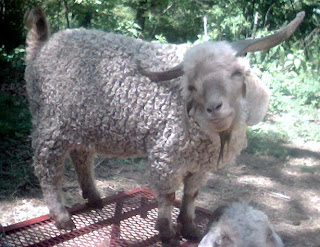
We have been debating on whether or not to change Angora herdsires. Can't make up our minds if we need to band The Sundance Kid (need to make a decision before it gets too late) or if we need to sell Copper Top. I am wanting to concentrate on black and white fleece in the Angora herd, Sundance would be the black herdsire we need. We have Copper Top a faded red, no black in his lines, though I am impressed with the kids he has produced this year.


Copper Top needing sheared.

Copper Top sheared


Copper Top scratching an itch


Look at the curl in the boys fleece. This is 2 days after shearing.

We could keep Sundance and Copper Top both as herdsires. But I don't really want 2 Angora bucks on the place. One of the issues I have with Sundance being herdsire is that he is a bottle baby. In our experience bottle baby bucks have a tendency to be more aggressive, more destructive, more annoying really. All bucks we have had with the exception of Axle and Copper have been bottle babies and they have been royal pains in the tuckus. Axle and Copper are the sweetest boys.


Gearing up for Cheesemaking classes.
Wanted to make sure I had all supplies, equipment and cultures needed. Have 3 students signed up. (I know not many, but it's a start).
Hoping to have the recipes and syllabus typed up before mid month.


Cheese Recipes


Natural Cottage Cheese

1 Gallon Goat Milk
Juice of 2 lemons
6 Tablespoons cream (optional)

  • Heat milk to 186 degrees.
  • Slowly add the juice of two lemons, or about 1/2 cup.
  • Cool until it can be handled.
  • Drain, rinse and salt if desired and add cream.

Use fresh as any cottage cheese.


Vinegar Cheese

1. While stirring frequently, heat one gallon of milk to 185 degrees F. (I use a homemade double boiler - pan inside of a pot)

2. Add 1/2 cup white vinegar, stir briefly. You should see curds form immediately.

3. Allow to set covered for 30 minutes, then strain through a cheesecloth-lined colander.

4. Tie cheesecloth and hang to drain. (about 6 hrs. or so)


Paneer

  • 1 gallon whole milk
  • 1/4 - 1/2 cup lemon juice

1. In a heavy saucepan, bring milk to a boil. Watch carefully to not let boil over or scorch. Add lemon juice and stir until small curds separate from the whey, about 2-3 minutes.

2. Let sit 10 minutes so curds can develop, then drain into a colander lined with 2 layers of cheesecloth. When cool enough to handle, tie up opposite ends of the cheesecloth and squeeze out remaining liquid.

3. Place paneer, still in cheesecloth, on a plate. Flatten to 1/2" thick and top with another plate. Rest something heavy on top of the plate and let sit 20 minutes.

4. Pour off any liquid that remains and refrigerate overnight, or use immediately by cutting paneer into 1/2" cubes and frying gently in oil, turning to brown each side.

Note: You might notice in the recipes that cottage cheese, vinegar cheese and paneer are basically made with the same ingredients. Though ingredients are the same the final product and type of cheese you end up with depends on how long you drain, if you press or crumble the curd, etc.

Note: Which is best white vinegar or lemon juice? I have used both, there is a slight difference in the taste, but not a noticeable one.

Note: When using salt in cheese recipes, it is best to use a cheese salt or sea salt.

June 1, 2008

Around The Farm

The peacocks are still strutting their stuff. All of the peahens must not be setting. They are extremely vocal and active today. At feeding time I noticed all were down from their perches early. When the boys are competing for the courtship honors they can rough house more than usual.
One of the boys decided I was deserving of his attention.


Showers and storms began yesterday afternoon, lasting til the wee hours of the morning. We have been so blessed as to only have thunderstorms with the worst of the weather missing us. I don't mind the rains, just stress during the severe weather warnings. Those nights are sleepless and stressful.

The pigs are the only animal on the farm that like the rain. The day after the storms, they are doing what pigs do best, rooting around in the mud and mess.

Miss Piggy, one of our feeder pigs.

Surprisingly Olive had the new babies out and about this morning. I was able to grab the camera before Olive decided it was time to take the babies away. You can barely see the chicks. They blend well into the background. One chick is directly behind her tail, the other three are following thru the grass. Yeppers, the little brown spots, the ones you wouldn't have any clue to as what they were if I didn't point them out.


In the photo below, one chick is at her tail, one is by her right foot (it is a lighter yellow than the others), the other two are at the end of the white vinyl.

That is as close as I can get without her whisking them away to safety. As they grow and start mainstreaming with the flock, we are planning to catch the babies this year. We have had so many people want peachicks, we think we can tame a few to sell. Think is the key word. We will see if we can.


I told Jim we are going to have to prepare a few roosters for the pot. They have decided to roost on and sleep in the nest boxes. Which aggravates me to no end. They leave their calling cards and the eggs are dirtier than normal. It's time for them to go!


The hens are now offering a dozen a day. The one little egg in front is actually a banty egg. The hens are one of the few farm animals that do pay their own way. The eggs sell quickly at $1.50 a dozen. By selling what we don't use, it pays for a portion of the feed bill.

Today's offering of a bakers dozen.